Can you use this scorecard for a major victory in your fight against atrophy?
 My secret plan that made personal history. You know it's that time of year again... You're thinking about your Resolutions for 2007. I recently asked about 200 people this one question: What is the one thing that you could start doing today that would improve the quality of your life?
They emailed their answers to me. I found that nearly ALL replies showed this answer: get more exercise, get in shape, and lose weight. So, I'm pretty sure you have similar goals. After all, exercise helps your heart and may prevent the onset of Parkinson's. Exercise positively clears up an atrophied mind.
Still, the hard part is fulfillment: DOING IT! Since I've been doing it for decades, I consider myself somewhat of an expert. Here's how I DID it... My 4-step plan on how to think, act, and mold a healthier body even if you can't lose weight! Plus new tricks to fight personal atrophy.
Step 1
I wrote down a list of things that I COULD do -- IF I were really going to exercise. I did NOT consider my list a commitment. I just jotted down my ideas -- even activities I had never done before.
Step 2
Alongside each activity, I jotted down how much time it would take -- IF I were to do that activity. This gave me some idea of when I could do it - IF I were to do it. I then wrote a possible schedule, based on my daily activities - IF I were to do it.
Step 3
I developed a "scorecard" that would show my participation -- IF I decided to do it.
Step 4
I thought about where I could post the scoreboard where I could see it as a daily reminder. By this time, my mind had been tricked into saying, "OK, I will schedule 6 days a week with Monday off."
(Notice the sudden enthusiasm and tendency to over commit!)
(Read on to get your bonus download!)
"OK Mike, what do you mean by scoreboard?"
I will show you actual scoreboards examples in a moment. First, let me explain. My scoreboard ROWS down the page show 1 row for each day in a month. Its COLUMNS across the page list all my exercise possibilities. That way, I can track everything.
Here are the exercises (columns) on my list:Walk, run, row/aerobic, jump rope, tai chi (fast set), hsing yi, ba gua, (open), (open), chest, back, Tibetan rites, chi kung, chi coiling, tai chi, stretch, abs.
Naturally, my list would be different from yours, should you choose to experiment with this idea.
I use the (open) columns for unspecified activities I want to include sometimes. Variety is the spice of life! I also have columns for recording data from my Polar Heart Watch (aerobic zone arrows), recovery time. If you get into aerobic training, you'll want a heart watch. I also have a column to record weight.
Do I do all these exercises everyday? Heck no! Just take a look at this scoreboard from last February when I was spending every minute writing a book.
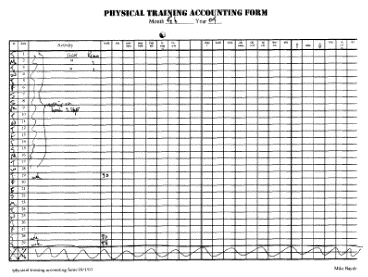
For this whole month, I only took three 30-minute walks! Here's a more typical scoreboard.
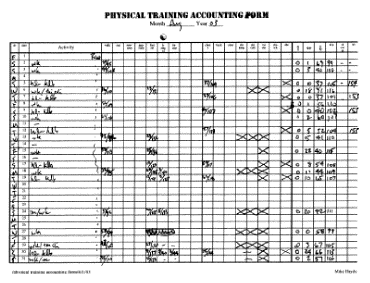
Obviously, I don't get around to every exercise every day or month. But, I have this theory that any exercise is 100 times better than no exercise.
OK, download this blank scoreboard (PDF file) that YOU can download and tailor for your own exercise program. Print out as many copies as you need. In this form, notice that I left right-hand columns for your aerobic zones (arrows) and weight.
Yes, but can you deal with your own mind?
When I am traveling, I usually run for exercise. It's a good way to relieve the atrophy from sitting all day. For example, here's a journal entry from a recent trip...
[...]From the motel, I run up a hill, turn left past the park where skate-boarders practice, then run the bridge across the Colorado River. Wow, that water is moving! I continue running to the lumberyard then turn around.
I run facing the traffic so I can see oncoming cars. Today's cars are so quiet they can sneak up from behind.
Some people are satisfied with running occasionally - or not at all. Fine. But, if you're going to run, I recommend some basic equipment. Good shoes (I check Runners Magazine for shoe evaluations) & running shorts.
I use a Polar Heart Watch for all aerobic training. For me, running without a heart watch is like driving without a speedometer. Also, I use a Timex watch with several timers and alarms.
I follow a written program that specifies a safe program of progress, and I keep a written progress record.
When running, I must deal with my friend, the mind. (The mind is the voice in the back of your head that sounds like you. It says things like,
"Ambition is a poor excuse for not having enough sense to be lazy.")I remember running everywhere as a kid. That was fun! Then, one day my mind said something like,
"Hey! What's the rush? Take it easy! Walking is fast enough. Sit down. Have a snack! Take a rest. Better yet, lie down. Take a nap."So, I quit running around. If you quit running as I did, then later decided to run, you probably discovered the mind's resistance. Even if you've run hundreds or thousands of miles, the mind will try to make deals like this ...
"Hey Mike, it's too cold and windy. Be careful! You might fall down. You've run enough for today. Stop. You can run longer tomorrow."Within 10 minutes, my mind quits whining and starts nagging like this...
"But I've only been running 90 seconds!"
"Hey, that's plenty! Don't overdo it! You might over-train and hurt yourself! You've got your whole life to train. Run a couple more minutes then have a donut!"
"A donut? You know I've sworn off donuts."
"OK, a brownie. You love chocolate! Look! There's the convenience store. It's OK. Just this once, pleeease!"
"Maybe I'll stop on the way back."
"That's too long! By then, you could be in the hospital because some idiot ran over you! C'mon, there's always tomorrow! Just walk today. You can always run tomorrow, OK?"
"NO DEALS! Tell you what. Check back with me in 10 minutes."
"Hey! Pick it up! You can't expect to improve when you run like a slug! Get Moving! ...yada...yada...yada..."It never ends.
The bad news: running causes heart, lungs, muscles, and bones to wear down. The good news: the body knows how to repair itself.
So, just tell your mind, "NO DEALS!" And keep training!
It's your move!
OK, my scorecard should help you get you started. It's your move. Some people say they aren't interested in exercise. I think it's a way to hide the fact that they simply don't think they can do it.
Are you really going to DO it this year? Or, are you going to just lay there like a chicken with its body cut off? But wait, I have one final question!
How could you use a scoreboard system like this to score a major victory in your fight against atrophy in your own business? Don't let atrophy stunt the growth of your business!
============================================================
Exercise for the Serious Organization Builder.
Download an updated (FREE) version of the Business Builder Outline (PDF file).
"Hi Mike ... thanks for your Business Builder outline ... good overview of what to plan for! I am about to launch my business ... and want to make it 'franchisable' ... a 'timely' download ... Thanks again, Ash"============================================================
HELP Profitable Venture Tactics help your colleagues.
This Blogrelies on subscriber's participation. So, it stands to reason, the more subscribers, the more participation. You can expand the circulation by telling your colleagues about Profitable Venture Tactics.
Your business and management colleagues will thank you for being so thoughtful.
What did you learn today that you found most beneficial?Please email your comments
How will you apply what you have learned at work?
Best Regards,
Mike Hayden, Principal/Consultant
Your partner in streamlining business.
PS. If you're not on our P V T Roster, click here PVT sign up (FREE)
PPS. Click here to sign up for the PVT Forum (FREE).
* * * * * * * * * * * * * * * * * * * * * * * * * * * * * *
(c) 2006 Mike Hayden, All rights reserved. You may use
material from the Profitable Venture Tactics eZine in
whole or in part, as long as you include complete
attribution, including live website links and email link.
* * * * * * * * * * * * * * * * * * * * * * * * * * * * * *






<< Home