


How to preserve nutritive values in the foods you buy 4.
 Millions Of People Are Better Cooks Today Because They Discovered How To Cook Vegetables!
In my previous blog(s) , I've been talking about how food handling and preparation affects some nutrients.
Holding and Reheating Vegetables
To save time, you may cook and save extra food for later meals, but this reduces nutrients. Reheating cooked vegetables causes more loss of nutrients, especially vitamin C.
The loss of vitamin C in cooked vegetables increases with the time held. You lose about 1/4 after 1 day in the refrigerator as when freshly cooked, about 1/3 after 2 days, etc. Cooked vegetables, reheated after 2 or 3 days in the refrigerator, will have only one third to one-half as much vitamin C as when freshly prepared.
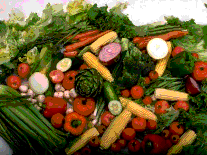
These losses need not cause concern you --if your meals include other, more dependable sources of vitamin C each day.
Be Vitamin-Wise When You Select Vegetables
___ In general, freshly harvested vegetables have more vitamins than those held in storage.
___ Make full use of vine-ripened tomatoes in summer when they are plentiful and inexpensive. Tomatoes vine ripened out-of-doors in summer sunlight have twice as much vitamin C as greenhouse tomatoes in winter.
___ You get several times as much vitamin A from bright orange, mature carrots than from pale colored, young carrots. Even so, young carrots are a good source of vitamin A; choose them if you prefer.
(Incidentally, only 30 to 40 adults a year experience liver toxicity from consuming too much vitamin A. In fact, a vitamin A supplement has never been reported to cause a death—and only a few reversible side effects are reported. Yet, while millions suffer vitamin A deficiencies, the FDA continues to warn adults of vitamin A toxicity.)___ Choose deep-orange sweet potatoes for maximum vitamin A.
___ Among the vegetables, turnip greens, kale, and collards are good sources of riboflavin and vitamins A and C. Lima beans, peas, and young cowpeas, including blackeye peas, contribute appreciable amounts of thiamin and protein.
___ Peppers are high in vitamins A and C.
___ The dark-green leafy vegetables are richer in nutrients, particularly vitamin A, calcium, and iron, than light-green vegetables.
___ Leaf lettuce has more vitamin A value than pale-green head lettuce. The dark-green, outer leaves of head lettuce are much higher in vitamin A value than the inner leaves. For maximum food value, look for dark green lettuce.
___ Potatoes, although not rich in vitamin C, are a good source of this nutrient when eaten regularly.
___ If the tops of beets are attached and still tender when you buy them, cook them—they are rich in vitamin A value.
Find out more in the next blog(s)! Stay tuned! (To receive this blog automatically, just enter your email address in the little window on the left and click Subscribe. Easy, eh? :)
... STOP! ... Are You Going To Miss Out On This Bargain! (Prices go up Feb 1, 2007.)
For a brief time, you can downloadThe Handbook of Hassle-Free Homecookin' (Acrobat-viewable) for just $2.97 US! Full printable version just $3.97 US. Regular retail price is $49 (for download). (I've added 248 pages since its first release in 1974!)
(Act now! Ridiculous LOW Price will be discontinued January 31, 2007!)
 Print and place The Handbook of Hassle-Free Homecookin' in a 3-ring binder and it becomes a GIANT 344-page manual you’ll want in your kitchen (or restaurant).
 (Photo taken with my el cheapo .5 mhz "digital pinhole" camera.)
Most "cookbooks" are recipe books that tell you WHAT to cook...
...But, The Handbook of Hassle-Free Homecookin' tells you HOW to cook -- whether you’re wondering how to cook a turkey, how to interpret cooking recipes, how to cook light, how to cook a prime rib, turkey cooking time, how to shop for cooking utensils, pot and pans ... you name it!
If you’re consuming soy products, you should read this series of articles for your health and enlightenment.
Bon Appétit
Mike Hayden
Slightly Famous Author of
The Handbook of Hassle-Free Homecookin'.
© 2007 Mike Hayden