Senior Management Services
Purging nightmares from business dreams.


NEW! The Ultimate Career Builder: "The book your boss wants you to read."
Cover Letters
Future-Proof Career!
Personality Test!
Super Affiliate Book!
CareerBuilderTools
SMS Blog
|

How SMS works - Article about Short Message Service (SMS)
NOTE: I give you following information because many people arrive at my site Senior Management Services (SMS) looking for information about how SMS (SHORT MESSAGE SERVICE) works. I wrote up this information in 2002 -- check to make sure things haven't changed by now.
(We are not in the SHORT MESSAGE SERVICE business, but we DO write technical documentation.)
CONTENTS:
SMS (SHORT MESSAGE SERVICE) Benefits
Why SMS (SHORT MESSAGE SERVICE) Usage Grows Dramatically
SMS (SHORT MESSAGE SERVICE) Applications
SMS (SHORT MESSAGE SERVICE) Phone Features
Wireless Application Protocol (WAP)
SMS (SHORT MESSAGE SERVICE) and the new Long Message Service
NETWORK ELEMENTS AND ARCHITECTURE
OVERVIEW OF SMS (SHORT MESSAGE SERVICE)
For a relatively simple messaging service, many elements must be considered when developing a server to handle SMS. The following overview information gives you the necessary background to understand the current implementation and to implement future upgrades.
Short Message Service (SMS) is a globally accepted wireless service that transmits alphanumeric messages between mobile subscribers and electronic mail, paging, and voice-mail systems, etc.
Message length can be:
160 characters for Latin alphabets, or
70 characters for non-Latin alphabets (ex: Arabic, Kenji, Chinese)
Unlike paging, short messages are stored by, and forwarded from, SMS centers. In the GSM (Global System for Mobiles) system, short messages are transmitted simultaneously with voice, data and fax.
SMS, a part of the GSM Phase 1 standard, has become an integral and important part everyday business and personal life, especially in Europe - over one billion messages per month in April 1999. Wireless Application Protocol (WAP) is a key market driver.
T0 TABLE OF CONTENTS
SMS (SHORT MESSAGE SERVICE) Benefits
SMS lets users use handsets as quasi computer extensions, providing integration of messaging services and data access. Thus, SMS eliminates the need for separate messaging devices. SMS service providers offer many services for SMS users including:
- Delivery of notifications and alerts
- Guaranteed message delivery
- Reliable, low-cost communication
- Ability to screen messages and selectively return calls
- Send same message to multiple subscribers
- Receive diverse information from many sources
- Generate E-mail
- Create e user groups
- Integrate with other data / Internet applications
SMS service providers' benefits include:
- Increased average revenue per user (ex: by leveraging SMS notification)
- An upgrade to alpha paging services
- Wireless data access for corporate users
- New revenue from added services such as e-mail, voice mail, fax, and Web applications (stock & currency quotes, airline schedules, etc.)
- Administrative services such as advice of charge, remote downloading and service provisioning
- Voice channels conservation due to SMS' limited channel usage
- Notification mechanisms wireless application protocol (WAP)
T0 TABLE OF CONTENTS
Why SMS (SHORT MESSAGE SERVICE) Usage Grows Dramatically
A typical network operator launches a two-way SMS capability. Customers then discover new uses for it, generating increased SMS volumes.
Network operators usually add a wireless email service, with the customer's mobile number becoming part of the email address. Emails sent to that address are forwarded as an SMS message to their wireless phone. This service is more popular in markets with low Internet penetration where people don't already have an email address. This also increases SMS volumes.
Network operators sometimes expand to offer information services (news, travel, weather, etc). These services tend to build more slowly due to the work involved to provide content. However, this can lead to increased SMS volume.
Competing network operators in the same geographical market, offer their customers a way to combine SMS and voice communication.
This alone can increase SMS volume up to 50%.
Anything that simplifies message generation increases SMS usage. Algorithms that predict the word a user is trying to generate reduces keystrokes, speeds input, and leads to even more SMS traffic. These predictive text algorithms support multiple languages.
Standardized protocols such as SIM Application Toolkit and WAP ultimately increase SMS usage because they provide a standard environment for application developers. Ease of service development also leads to increased SMS volumes.
Smart phones also make it easier for users to access messaging services via keyboard instead of limited mobile phone keypads - also leading to increased SMS volumes.
Thus, total SMS usage can quickly reach "Critical Mass."
T0 TABLE OF CONTENTS
SMS (SHORT MESSAGE SERVICE) Applications
Consumer applications (as opposed to corporate applications) account for most SMS usage - up to 90% of network operator's SMS traffic. A brief list of consumer SMS applications includes:
- Person to person messaging
- Voicemail / fax notifications
- Email alerts
- Information services
- Chat
Other services can include "unified messaging" (one source for messages) and "ringtones" (special ring-tones to identify certain callers).
Currently, corporate SMS applications are rare. Younger consumers generate most SMS volumes while corporate users tend to communicate by email and voice. Some corporate SMS applications include:
- Corporate Email
- Job Dispatching
- Mobile Banking
- Customer Service
- Electronic Commerce
- Vehicle Positioning
- Remote Monitoring
- Remote Point-of-Sale
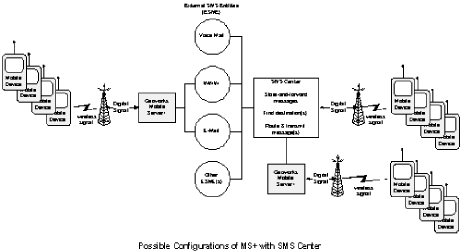
Figure 1 below shows two ways MS+ can be placed in an SMS network.
T0 TABLE OF CONTENTS
SMS (SHORT MESSAGE SERVICE) Phone Features
Nearly all GSM mobile telephones can receive SMS. Exceptions include early 1990's GSM mobile phones such as the Motorola 3200, the AEG Telcard 901 and the Alcatel HB100.
All phone manufacturers now have at least one mobile phone that can send short messages. Most budget phones can send messages. The percentage of SMS phones that can send short messages is increasing.
T0 TABLE OF CONTENTS
SIM Application Toolkit
The GSM standard includes a SIM Application Toolkit. The "SIM" is a smart card in GSM mobile phones that contains user information.
The SIM Toolkit, a client-server application, is used for applications needing high security such as mobile banking. The SIM Toolkit is also used for "static" information services such as hotlines, company directories and yellow pages. WAP is used for "dynamic" services like browsing the Internet and accessing dynamic information services.
The Toolkit also allows network operators to remotely personalize each user's SIM to identity verification and security functions essential for secure electronic commerce. Some network operators stipulate that all phones on their network must support SIM Application Toolkit.
T0 TABLE OF CONTENTS
Wireless Application Protocol (WAP)
The Wireless Application Protocol (WAP) is a standard for how Internet content is filtered for mobile communications. WAP combines two of the fastest growing industries, wireless and the Internet, and is a scaleable protocol for use with:
- any mobile phone from a one-line display to a smart phone
- any existing or planned wireless service
- any mobile network standard (CDMA, GSM, UMTS, etc.)
- multiple input terminals such as keypads, keyboards, touch-screens and styluses
WAP incorporates a micro-browser into a mobile phone. This turns a mass-market mobile phone into a "network-based smartphone."
However, WAP requires a larger screen and more memory, which costs more. Thus, today's heavy SMS users (consumers) won't use WAP until it is standard on low-cost phones. This will delay WAP's market penetration. On the other hand, some phone vendors, such as Alcatel, have announced WAP support for all their products.
T0 TABLE OF CONTENTS
SMS (SHORT MESSAGE SERVICE) and the new Long Message Service
Will SMS thrive as GSM evolves to high-speed packet data services like General Packet Radio Service (GPRS) (See http://www.mobileGPRS.com).
Current GSM SMS technology offers unique features such as:
- message storage if recipient is not available
- confirmation of message delivery to the sender
- simultaneous transmission with GSM voice, data and fax services
However, these features are not planned for future long-message GSM services such as GPRS. Further, SMS has the disadvantage of 160 characters, max.
Experts predict that today's SMS format will be used through 2005, or later, because the SMS infrastructure, specifications, and market are here today (2001).
However, users with new mobile terminals will connect to advanced data services, and may want to receive selected emails instead of SMS notification, meanwhile using SMS for other applications.
For example, they might use SMS when roaming for its advantage of store and forward in different time zones. Urgent emails could be sent immediately via packet data, while non-urgent emails could be sent by SMS so users can decide whether to forward the whole message.
WAP anticipates support for multiple services via multiple standards and bearer services. In UMTS, SMS will be only a part of multi-media messaging. Different applications will use different bearer services, which will be mixed and matched depending on application features and mobile environment.
T0 TABLE OF CONTENTS
NETWORK ELEMENTS AND ARCHITECTURE
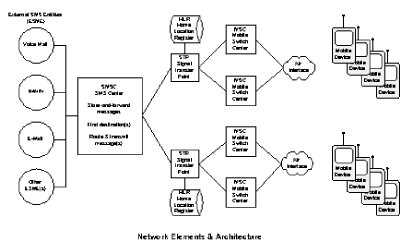
Figure 2 below shows the basic network structure of the SMS in an IS-41 network.
T0 TABLE OF CONTENTS
SIGNALING ELEMENTS
Both American and international standards specify a MAP layer using the services of the SS7 TCAP. The MAP layer defines necessary operations for supporting SMS.
The Telecommunication Industry Association defines the American standard (IS-41). The European Telecommunications Standards Institute (ETSI) defines the International standard (GSM MAP).
T0 TABLE OF CONTENTS
Service Elements
SMS is comprised of several service elements for receiving and submitting short messages:
Message Expiration&emdash;The SMSC will store and reattempt messages delivery to unavailable recipients until successful delivery or expiration timeout (per-message or platform-wide basis).
Priority&emdash;This information element, provided by an SME, specifies urgent versus normal priority messages. Urgent messages usually take priority over normal messages, regardless of arrival time to the SMSC platform.
Message Escalation&emdash;The SMSC stores the message until expiration time; after escalation time, the message will be sent to an alternate message system (such as a paging network or an e-mail server).
Also, SMS time stamps the message upon SMSC arrival, then tells the handset whether there are more messages to send (GSM), or some (number of) additional messages to send (IS-41).
T0 TABLE OF CONTENTS
Subscriber Services
SMS comprises two basic point-to-point services:
- Mobile-Originated short message (MO-SM)
Sent from the MO-capable handset to the SMSC; can be destined for other mobile subscribers or for fixed-network subscribers (paging networks or Internet protocol (IP) networks (including Internet and private e-mail networks)).
A report is always returned to the handset confirming SMSC message delivery or delivery failure with reason (cause code).
- Mobile-Terminated short message (MT-SM)
Sent from the SMSC to the handset; can be submitted to the SMSC by other mobile subscribers via MO-SM or by other sources such as voice-mail systems, paging networks, or operators.
A report is always returned to the SMSC confirming message delivery to the handset or delivery failure with reason (cause code).
T0 TABLE OF CONTENTS
DEFINITIONS
Air Interface
Specifies, for each wireless technology (GSM, TDMA, and CDMA), how to transfer voice or data signals from the MSC to/from the handset; also specifies use of transmission frequencies.
BS
Base Station
Performs all functions related to transmission of radio signals between the MSC and mobile devices. BS consists of base station controllers (BSCs) and base transceiver stations (BTSs), also known as "cells." May control one or more BTSs. Assigns resource(s) when a subscriber moves from one sector to another.
CMT
Cellular Messaging Teleservice
CPT
Cellular Paging Teleservice
ESME
External Short Messaging Entities
A device that may receive or send short messages. The short message entity (SME) may be located in the fixed network, a mobile device, or another service center.
Gateway
(1) A computer that performs protocol conversion between different types of networks or applications (a TCP/IP packet to/from a NetWare IPX packet, or AppleTalk to/from DECnet, SNA to/from AppleTalk etc.).
Gateways operate at layer 4 and above in the OSI model, performing complete conversions from one protocol to another (rather than simply supporting one protocol from within another). Sometimes routers can implement gateway functions.
An electronic mail or messaging gateway converts messages between two different messaging protocols.
(2) A computer that acts as a go-between for two or more networks using the same protocols. In this case, the gateway functions as an entry/exit point to the network. Transport protocol conversion may not be required, but some form of processing is typically performed.
GPRS
General Packet Radio Service
GSM
Global System for Mobiles
HLR
Home Location Register
A database for permanent storage and management of subscriptions and service profiles. The HLR provides subscriber routing information to the SMSC. Also, for delayed message delivery (busy), the HLR tells the SMSC when the message can be delivered (station available now).
IP
Internet Protocol
The IP part of TCP/IP communications protocol. IP implements the network layer (layer 3) of the protocol, which contains a network address for routing a message to a different network or subnetwork. IP:
- accepts "packets" from the layer 4 transport protocol (TCP or UDP),
- adds its own header to it and
- delivers a "datagram" to the layer 2 data link protocol.
- may also break the packet into fragments to support the maximum transmission unit (MTU) of the network.
MAP
Mobile Application Part
Defines communication methods and mechanics of wireless networks; uses SS7 transaction capabilities application part (TCAP). The SMS service layer uses MAP signaling and facilitates short message transfer between equal entities.
Mobile Device
Wireless terminal capable of receiving and originating short messages. SMS has been extended mobile devices such as POS, handheld computers, and personal digital assistants (PDAs).
MO-SM
Mobile Originated Short Message
MSC
Mobile Switch Center
Performs system switching functions and controls calls to / from other telephone and data systems. Delivers the short message to the specified mobile device through a base station.
MT-SM
Mobile-Terminated Short Message
OSI Model
Application - Layer 7
Layer 7 (top layer) defines the language and syntax for programs that communicate with other programs. The Application Layer satisfies the purpose of communicating in the first place. For example, a workstation program uses commands to request data from a server program.
Common functions at this layer are:
- opening, closing, reading and writing files,
- transferring files and e-mail messages,
- executing remote jobs and
- obtaining directory information about network resouces.
Presentation - Layer 6
When data is transmitted between different types of computer systems, the Presentation Layer negotiates and manages the way data representation and encoding. For example, it provides a common denominator for ASCII and EBCDIC machines and for different floating point and binary formats. Sun's XDR and OSI's ASN.1 are two protocols used for this purpose.
This layer is also manages encryption and decryption.
Session - Layer 5
The Session layer coordinates communications. It determines one-way or two-way communications and manages dialogue between parties. For example, Layer 5 makes sure the previous request is complete before the next one is sent. It also marks transmitted data with checkpoints to allow fast recovery if there's a connection failure.
In practice, this layer is often not used or services within this layer are sometimes incorporated into the Layer 4.
Transport - Layer 4
The transport layer assures integrity of end-to-end transmission. The Data Link Layer (Layer 2) only delivers packets from one node to another. So, if a packet gets lost in a router in the enterprise internet, this layer detects the loss.
Layer 4 ensures that if a 12MB file is sent, the full 12MB is received.
"OSI Transport Services" include Layers 1 through 4, collectively assures error-free delivery of a complete message or file from sender to receiver.
Network - Layer 3
This Layer establishes the route between sending and receiving stations. The node to node function of the Data Link Layer (Layer 2) extends across the entire inter-network, because a routable protocol contains both network and station addresses.
This layer is the switching function of the dial-up telephone system and functions performed by routable protocols such as IP, IPX, SNA and AppleTalk. If all stations are contained within a single network segment, then routing capability in this layer is not required.
Data Link - Layer 2
The Data Link assures integrity of node to node transmission. Transmitted bits are divided into frames; for example, an Ethernet, Token Ring or FDDI frame in local area networks (LANs). Layers 1 and 2 are required for every type of communications.
Physical - Layer 1
The Physical Layer is passes bits to / from the connecting medium. This layer interprets no bits, but handles electrical and mechanical signal characteristics and signal methods. For example, it comprises the RTS and CTS signals in an RS-232 environment, and TDM and FDM methods for multiplexing data on a line. SONET also provides Layer 1 capability.
SME
Short Message Entity
An entity that can send/receive SMS messages.
SMSC
SMS Center
A combination of hardware & software that stores / forwards / relays SMS messages between an SME and mobile device.
STP
Signal Transfer Point
A network element that allows IS-41 interconnections over signaling system 7 (SS7) links with multiple network elements.
UMTS
VLR
Visitor Location Register
A database containing temporary subscriber information (homed in one HLR, roaming in another HLR) needed by the MSC to service visiting subscribers.
VMN
Voice-Mail Notification Teleservice
VMS
Responsible for receiving, storing, and playing voice messages intended for a subscriber not available for a voice call; also sends voice-mail notification to the SMSC.
T0 TABLE OF CONTENTS
We can help you get organized (Shameless Promotion).
Most managers these days suffer increasing pressure to slash costs and get more done with fewer people.
I work with managers and executives to relieve this pressure of having to boost production and profits with fewer people. I like to say, "We take the pressure off!"
But, I don't know whether we can do the same for you because I don't know you.
But, if we COULD relieve your worries, would you like to learn more? If we can't increase your profits and save you time, money and trouble - you pay nothing!
I fully expect your costs to be a small part of your increased profits and savings (making our service essentially FREE!)
Find out for yourself! You have nothing to lose.
Over two decades, SMS has saved time, money, and effort for scores of companies in Silicon Valley (and from Toronto to Hong Kong)! This means you benefit from techniques proven successful on over 300 projects.
You decide. Don't let Dis-Organization stunt the growth of your business!
First, (if you haven't already) sign up for Profitable Venture Tactics eZine so we can become better acquainted.
When you're ready to get started, just call (303) 585-1945 for a Free Needs Analysis.
To Your Business Success,
Principal/Consultant
Your partner in streamlining business.
................... "CLIENT COMMENTS" ................. "Interaction with our personnel is effective ... services free of problems."-- M.M., System Network Manager, IBM/ROLM, Santa Clara, CA. "... professional and appropriate ... always punctual ... well coordinated."
-- J.C., System Engineer, IBM/ROLM, San Jose, CA
.......................................................

(c) 2003 Mike Hayden, All rights reserved. You are free to use material from the Profitable Venture Tactics Ezine in whole or in part, as long as you include complete attribution, including live website link and email link.

Senior Management Services
9457 S. University Blvd. Suite 235
Highlands Ranch, CO 80126
Fax: (952) 674-1767

"... knowing you were available for consulting and tips gave me the security to go about my tasks without fear of being 'out there alone.' Your techniques and skills are quite valuable, keep sharing them!" B.J., Consultant, San Francisco, CA.
"... recently I had the good fortune of coming across your informative newsletter ... please add me to your mailing list. Thank You." S.M.G., Principal, Harbrace House, Irvine CA.
